Here are 3 case studies that I'm most proud of. If you want to see more pure design fluffy stuff, please visit my Dribbble (side note, you'll see some logos on my Dribbble - I hate logo design. It's the worst. But I thought some of the ones I did were kinda cute, so I left them in my portfolio).
Anyways, carry on.
You've probably seen the traditional innovation design squiggle that looks something like this:

In my experience, innovation looks more like this:
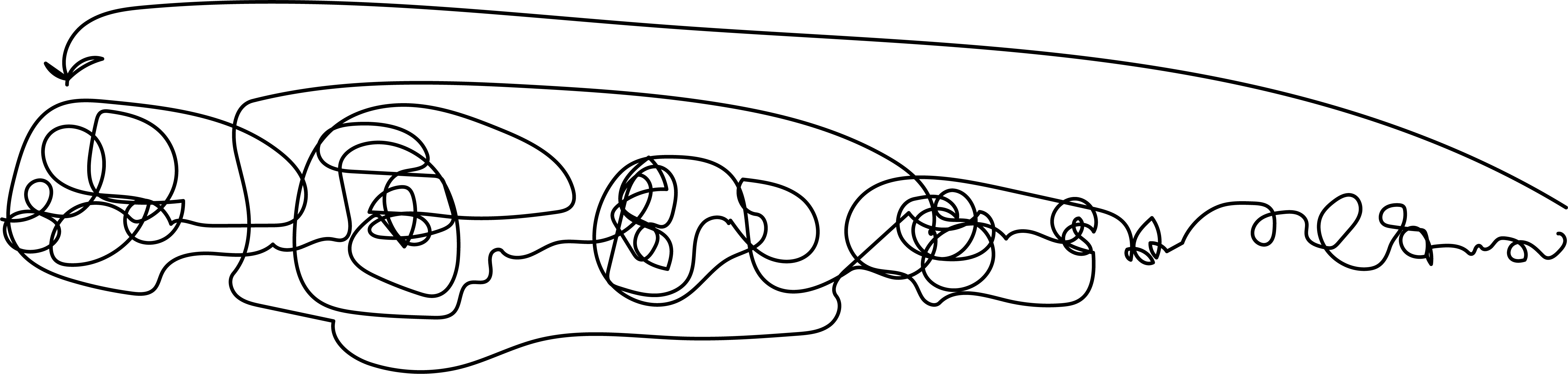
But it is my job to make it as unsquiggly as possible and test innovative ideas / products rapidly and cheaply to derisk investment. To be a Validation Innovation Consultant means to be a product strategist, creative developer, a designer, an analyst, a prototyper, a project manager - all in one. That is the key to define Venture Design Validation.
"Venture Design is the process of identifying and forming new business opportunities using human-centred design principles. Rather than leaving a startup to be created by chance, venture design allows businesses to be created [with intentional iterative testing]." Founders Factory
Below goes into the methodology for validation new ideas with some real examples where I was the Validation Lead.
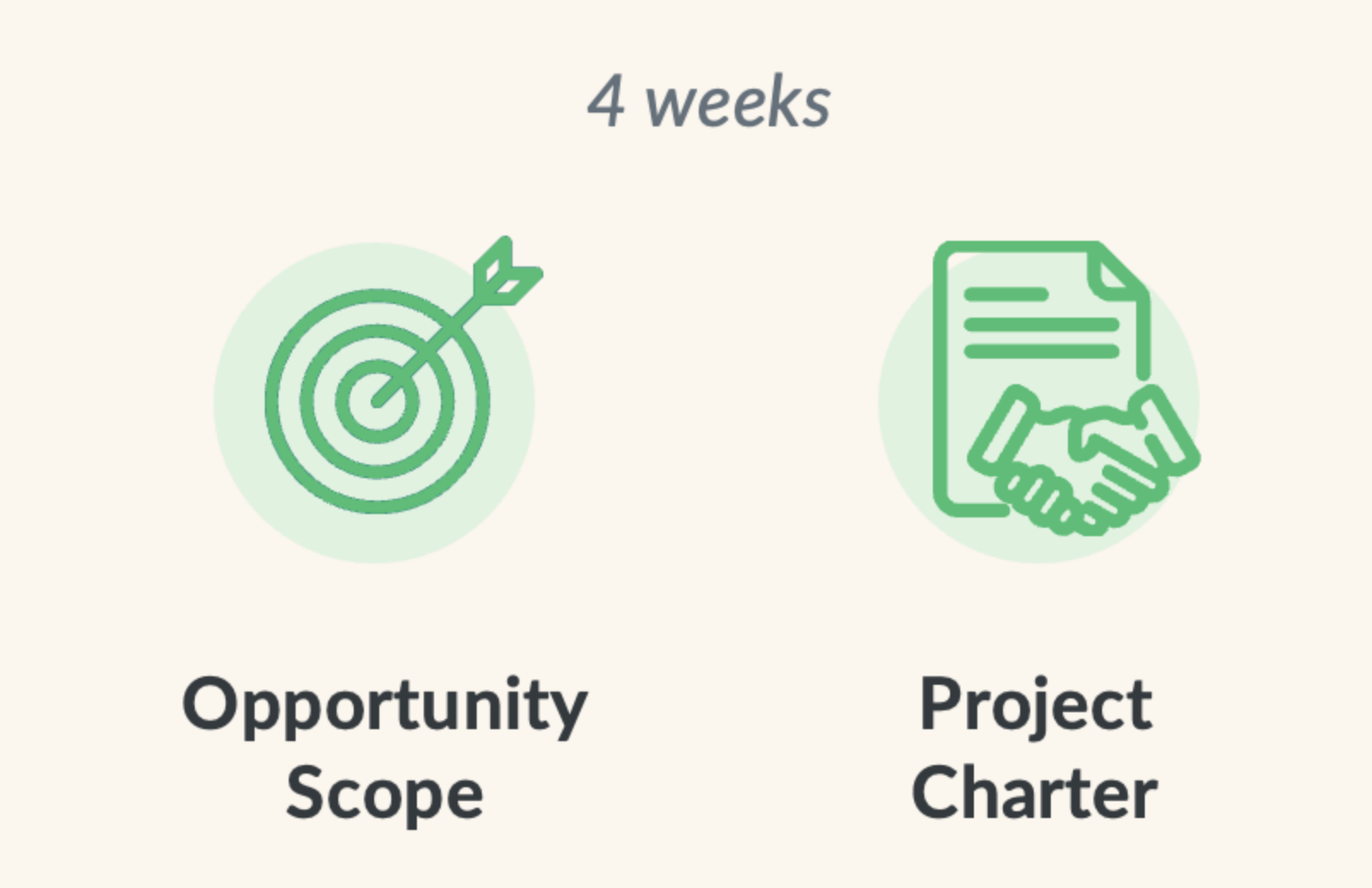
In Framing, we scope gargantuan, future state opportunities that are ambiguous. For example: How might we authentically know our underserved care seekers better so that we can provide the services they need in the right context for them? If we solve for it, one outcome will be that we can maximize the chance of having enough culturally appropriate provider options for our members. And then by solving for this big problem of culturally competent provider care deserts, we can gain and retain members in new markets.
So we know what the opportunity is and what we want the outcome of the solution to be.
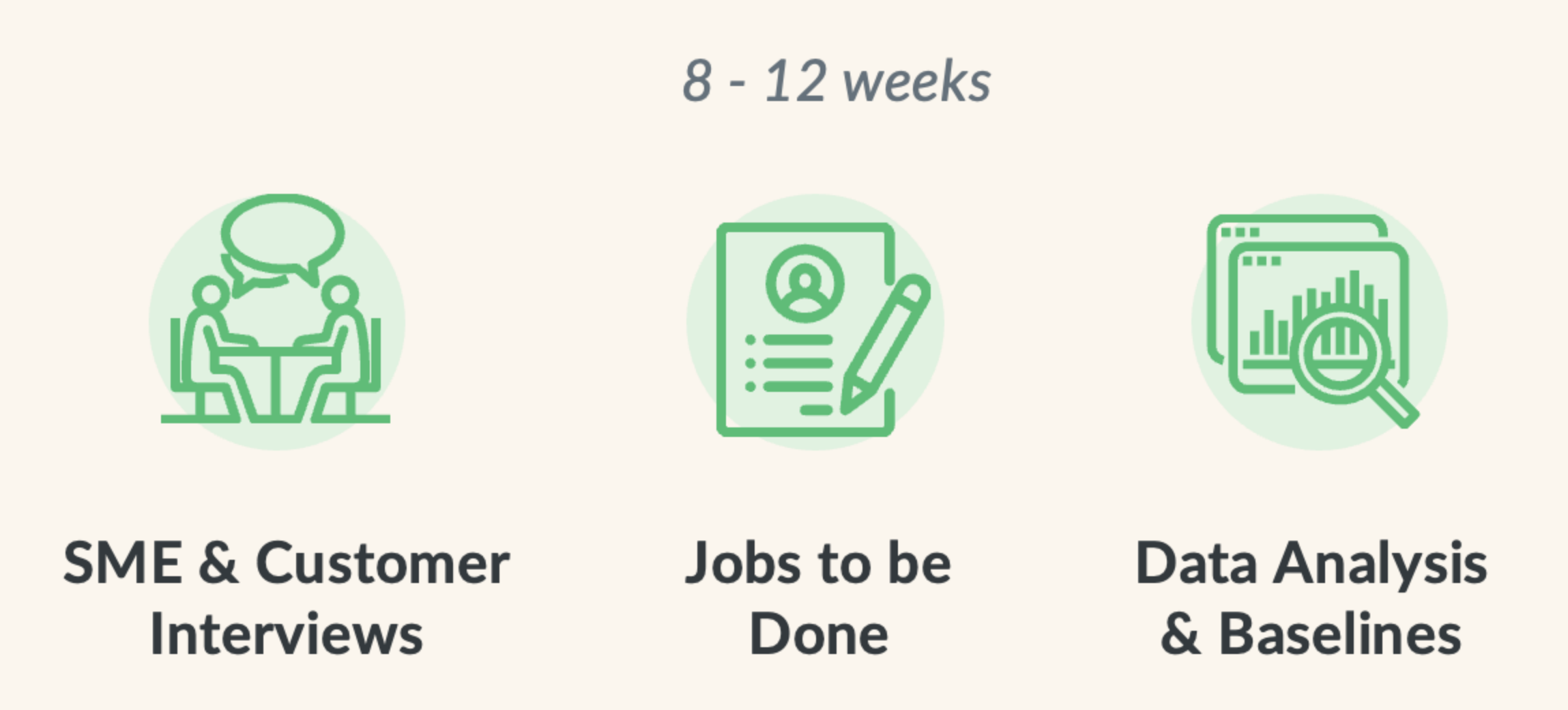
Next comes Discovery – basically, we are understanding customer-facing gaps, uncovering customer pain points, motivations, and unmet needs.
Following the example from framing, how might we prioritize the most critical problems that stand in the way of new members receiving culturally competent care? We interview members, non-members, internal subject-matter experts, external partners who interact directly with the markets, and pour over data and market research.

Between Discovery and Validation is when we do co-design sessions and ideation. We do co-design sessions, brainstorming sessions, and independent work. Then we bring those ideas into the Validation Lab!

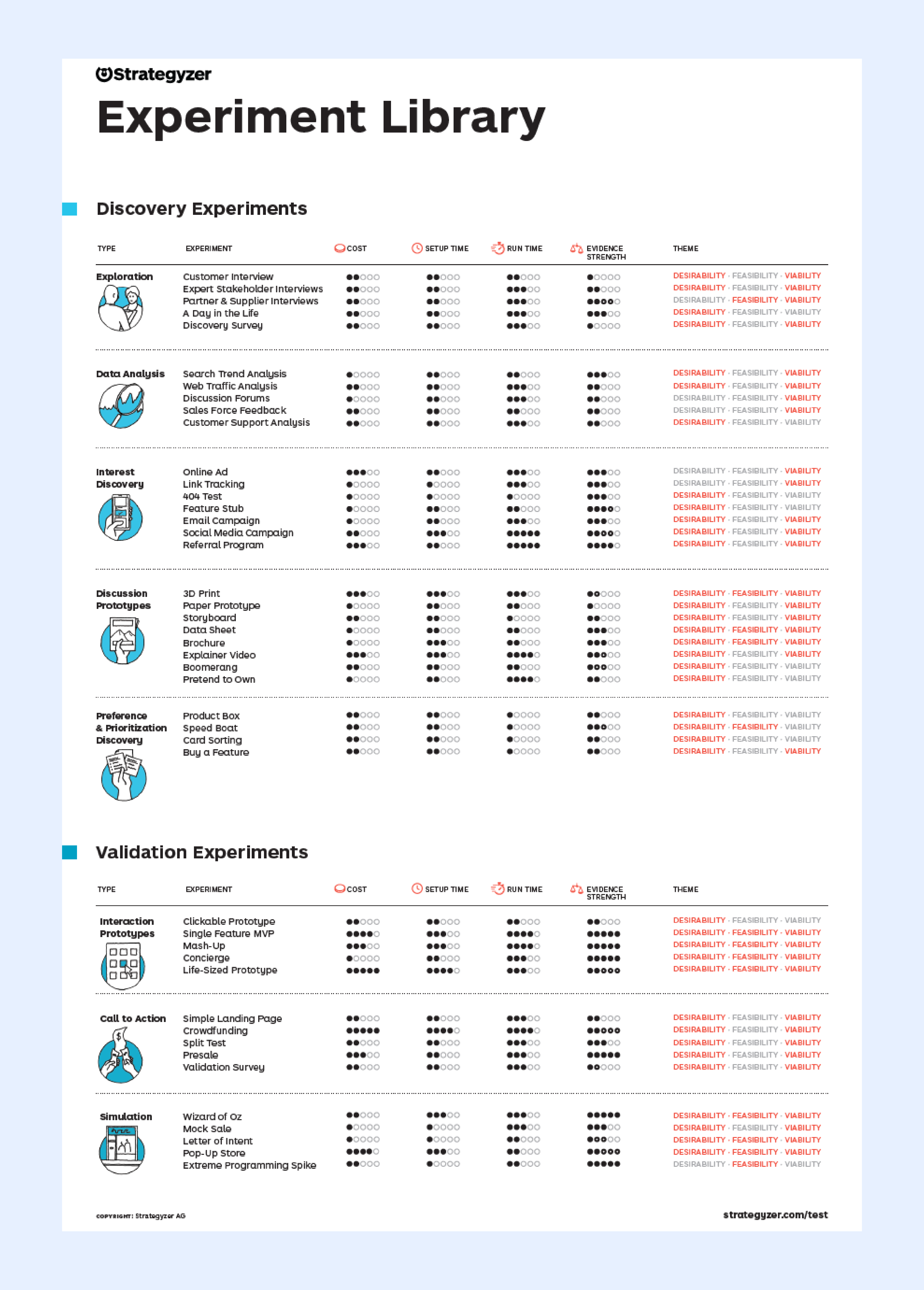
The Validation Lab is the virtual environment where we house the artifacts and outputs of the experiments. It can also be where we build models or host landing pages and application prototypes. Experiments are tests escalating in fidelity that start with "Say" evidence (customers think it's a good idea and they'd use it) to "Do" evidence (customers actually sign up, buy it, reserve it, use it, etc.).
We run these experiments in order to de-risk the investment.
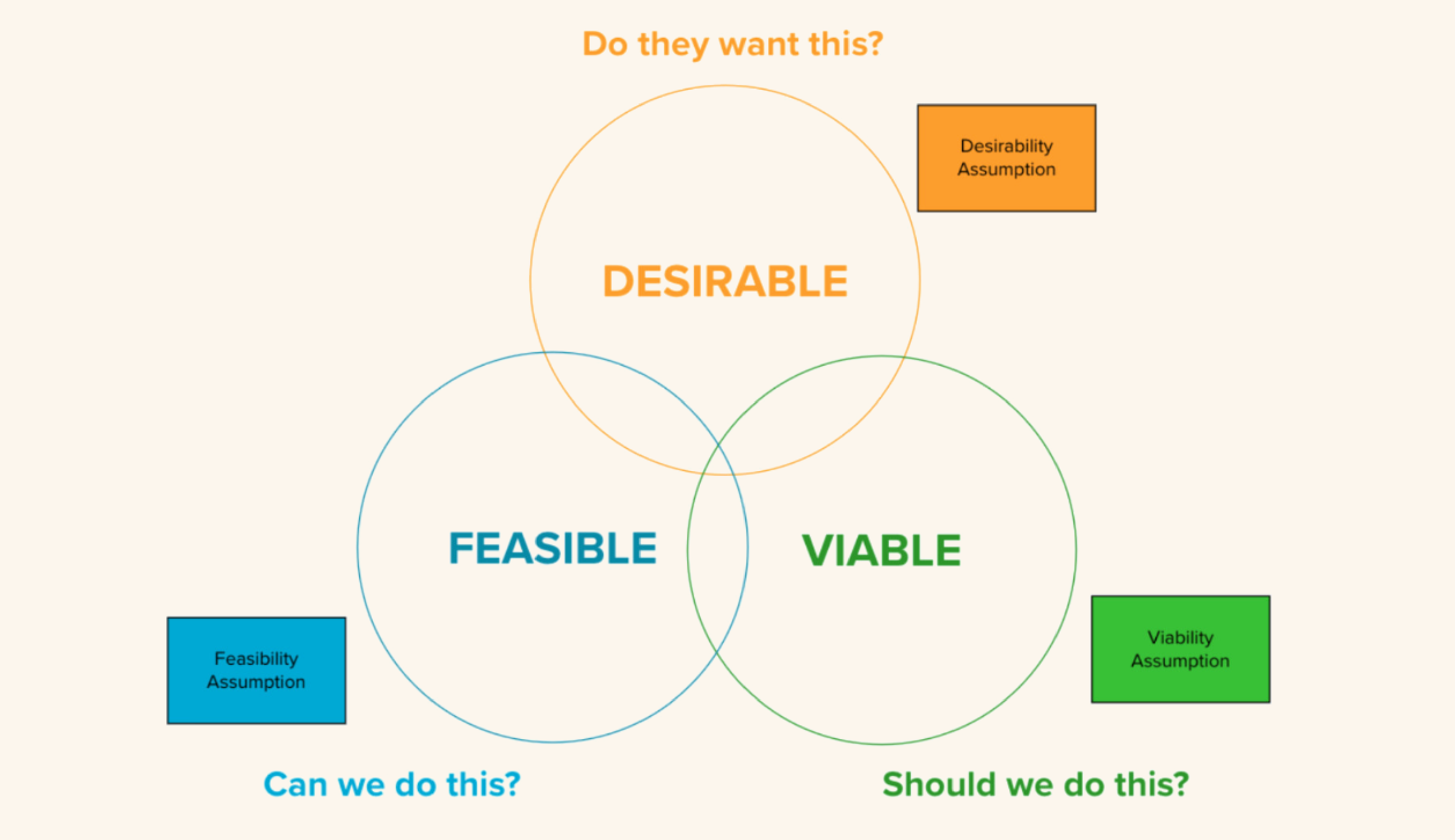
The three areas of risk represent the three business blocks of a business model:
The Business Model Canvas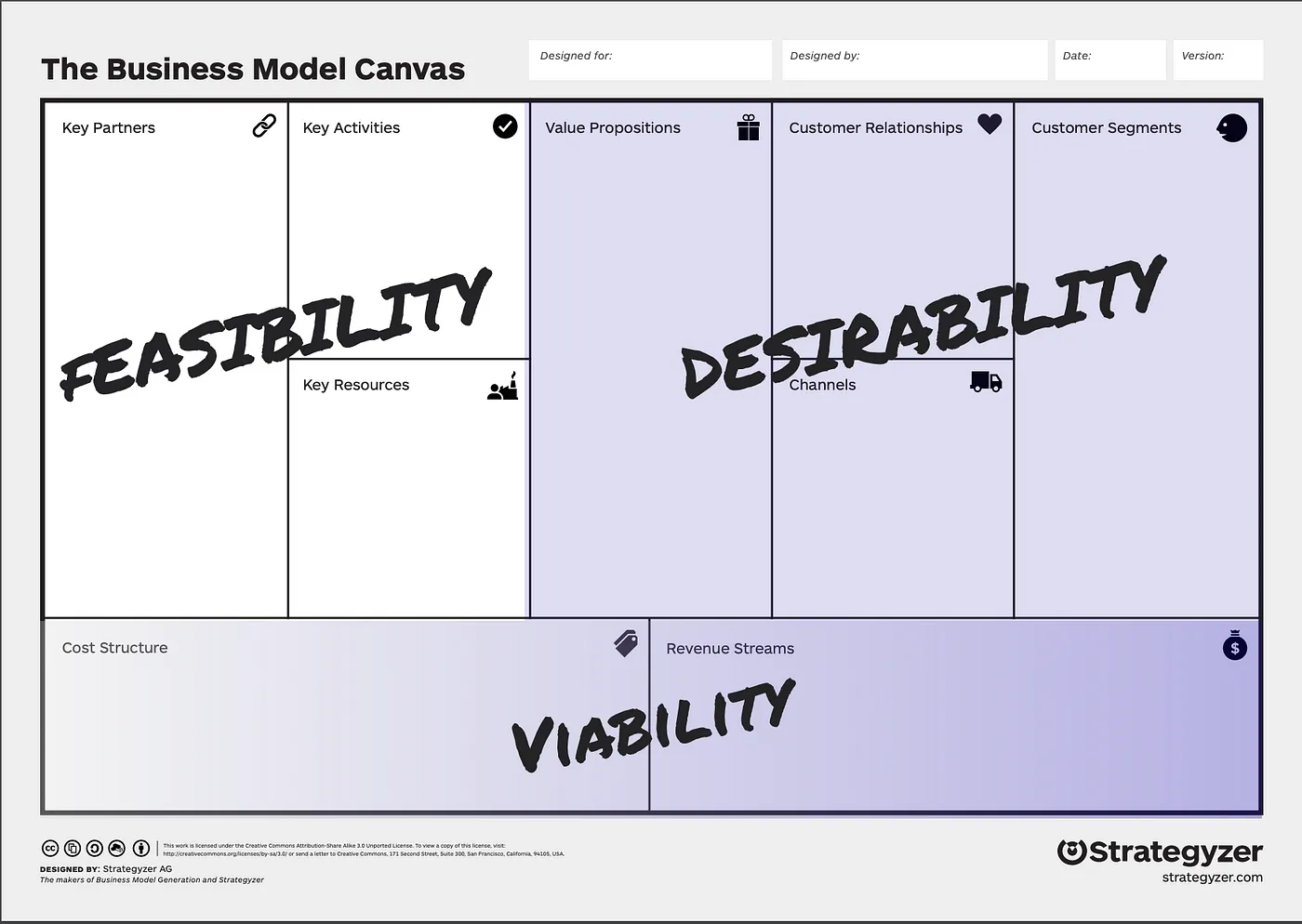 Investing into new products or business based on assumptions is risky
 Library of tests / experiments to de-risk assumptions
Desirability Tests
Do customers even want this? This is where we might spin up fake brands and use landing pages to test a customer's willingness to engage and get their qualitative thoughts on the product.
Tests go from light "say" evidence from surveys and co-design sessions with users to heavy market "do" evidence with pilots.
After running the tests where the concept designs would go through rapid iterations, I then compile the findings with recommendations for our business partners to make the final decision on whether to pivot, shelf, or perservere.
Primary tools used: Figma / Adobe XD, Lyssna, Survey Monkey, Miro, sticky notes, white boards
Below are some examples of fake brands I've created in less than a day - the goal is to throw something to market fast, without there even being a product developed yet.
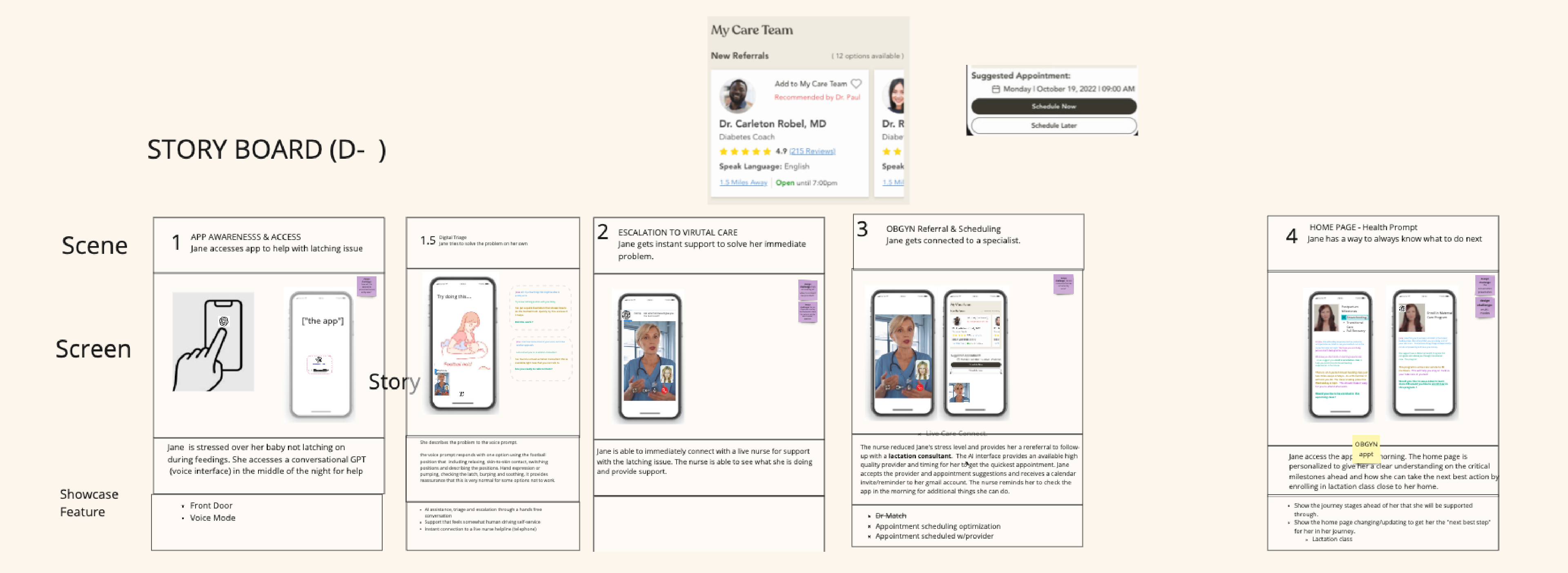
Conceptual landing pages and mockups that were used with customers to test assumptions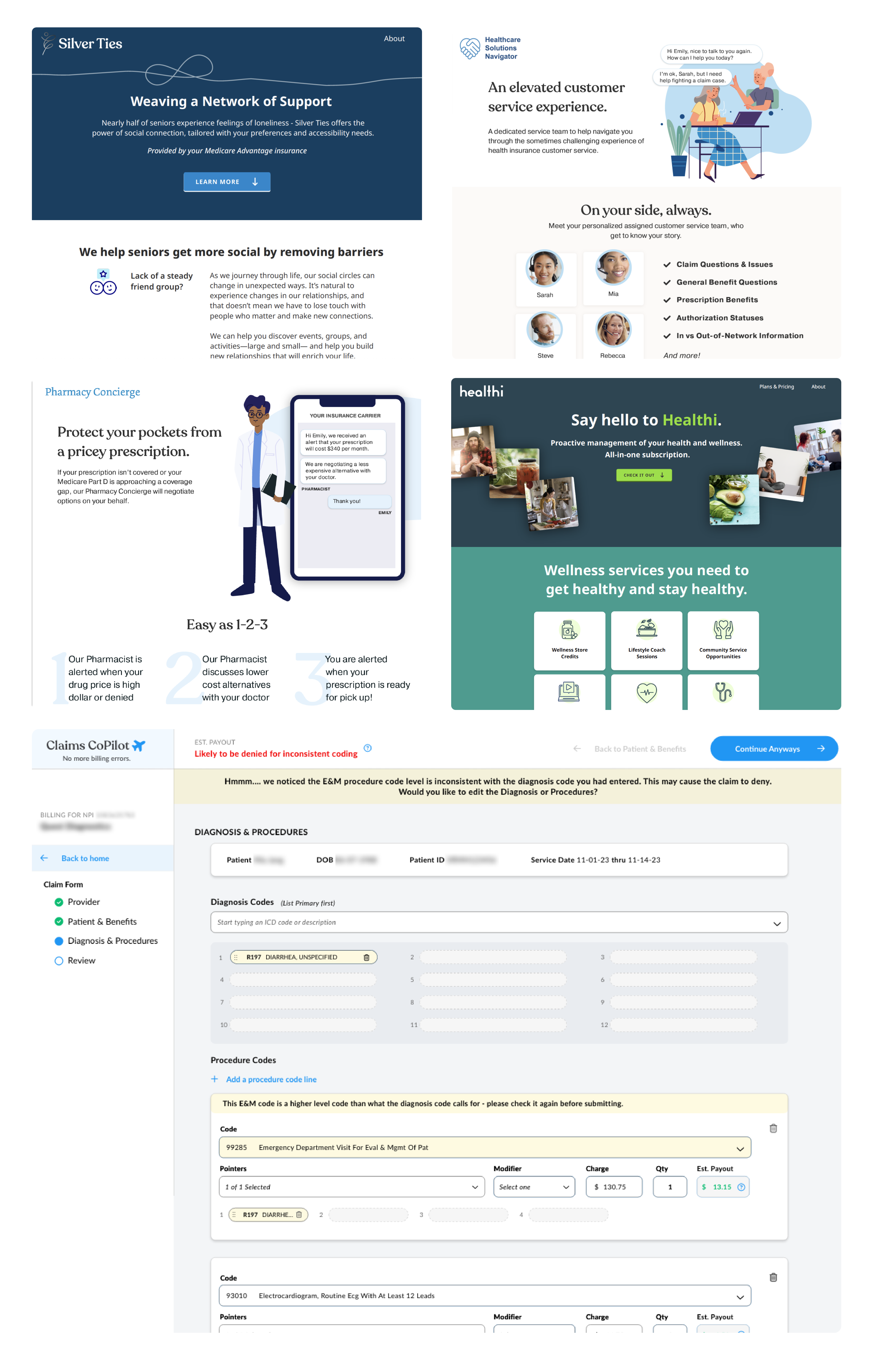 A story board that I then developed into a prototype - click here to run through the demo. Made for mobile screens.
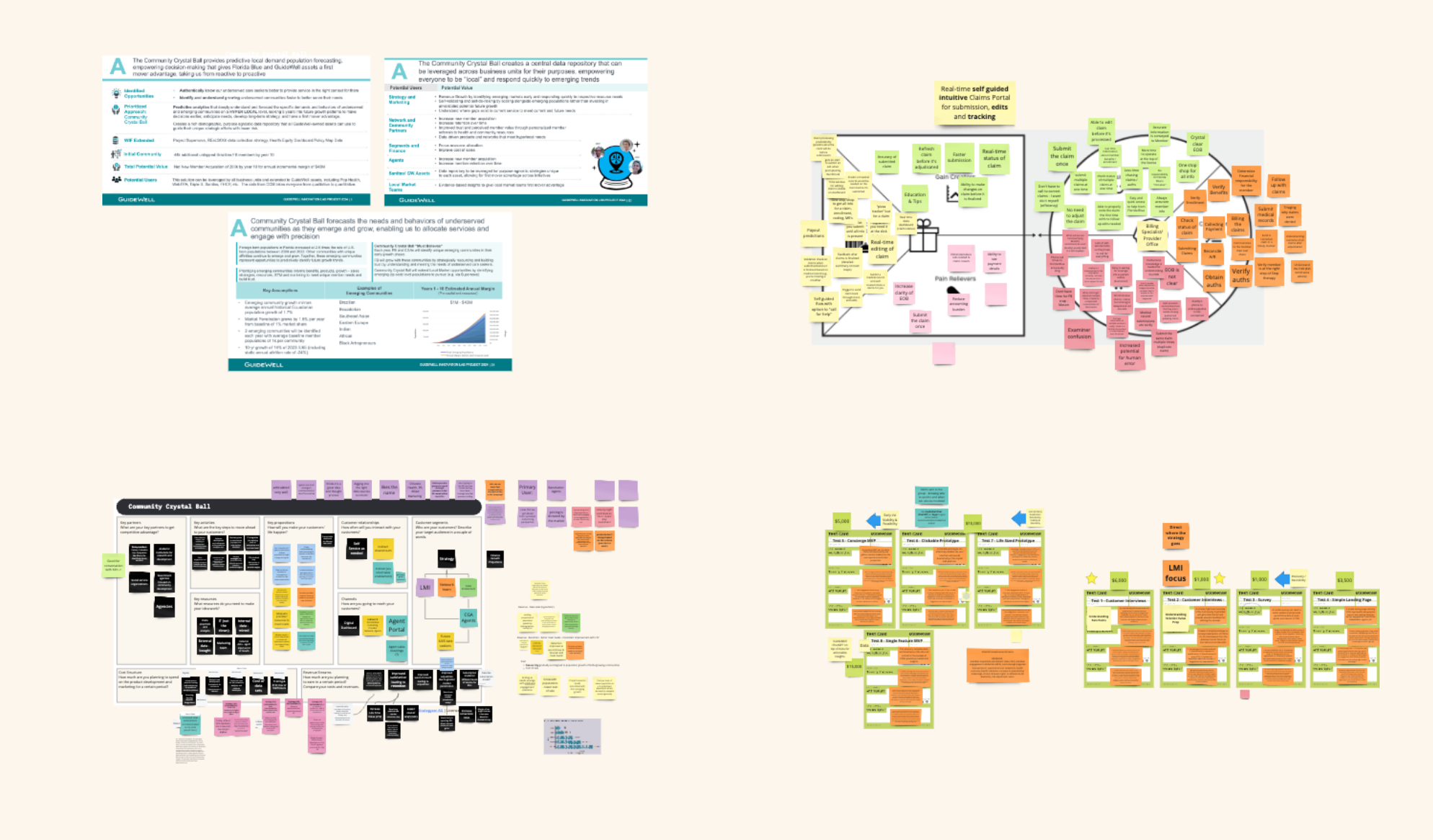
 Different artifacts of the validation process - Concept cards, Business Model Canvas, Value Proposition Canvas, and Test Cards
Feasibility Tests
How do we build this and do we build / buy / or partner? This is where we get technical and start diving into the architecture of the product, data needs, AI modeling needs, etc.
This is an overview of a backend architecure diagram I created for a simple Chat Assistant app using Open AI's 4o model.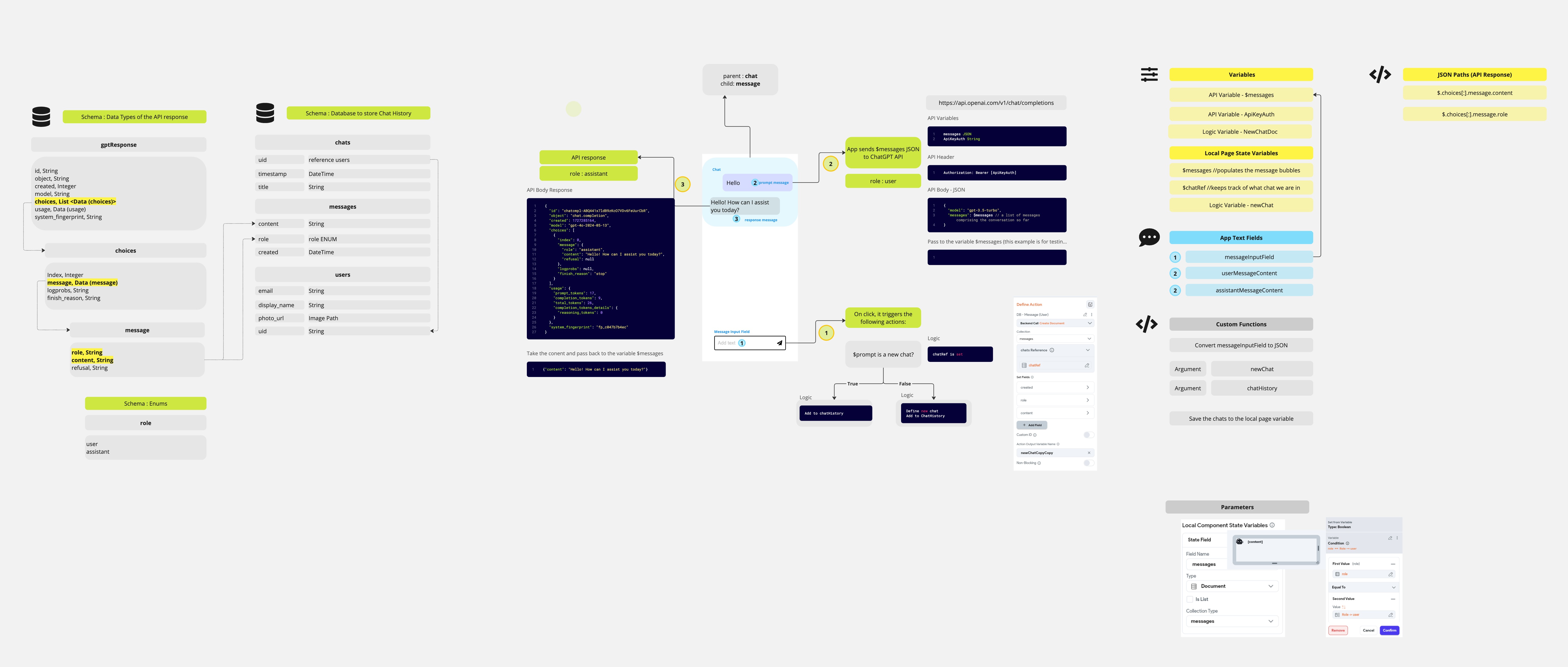
Viability Tests
Even if the product or service solves a customer's pain point, it's no good if we can't sustain it as a business. KPI's I test the product against include:
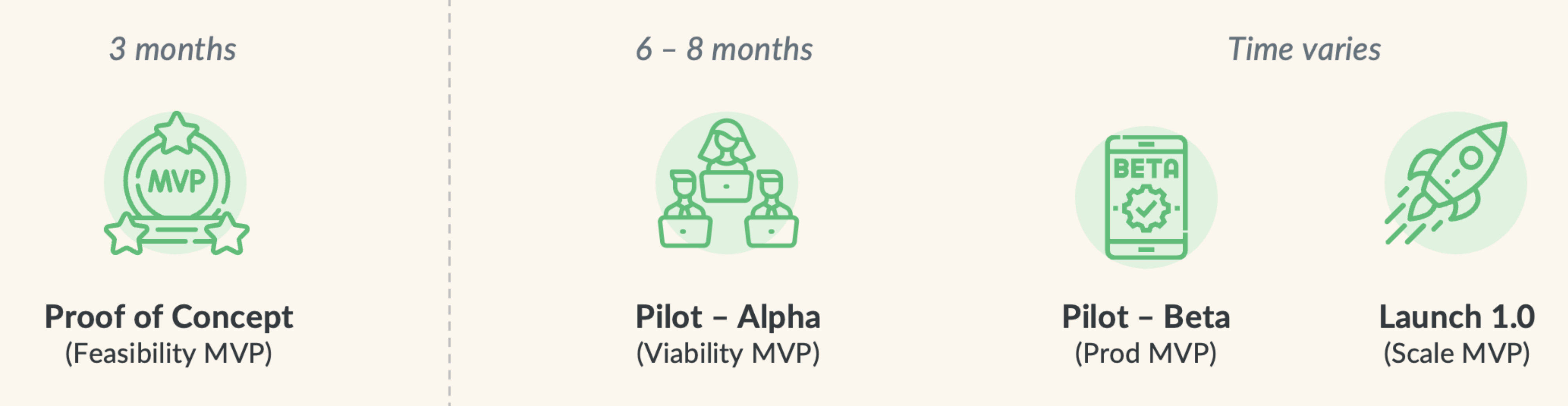
After going through multiple iterations, prototyping, customer design sessions, etc., if all signs point to "Go," we go for a proof-of-concept to test feasiblity in a production environment with real information. Previous feasibility testing might have been in production, but would have used synthetic data for HIPAA compliance.
POC's are usually very limited, with no connection to other systems, and usually 1,000 customers or less. This is usually what most businesses call a Pilot, but at GuideWell we had a step before Pilot because in order to secure funding for a scaled Pilot, data from a Proof of Concept was very impactful.
Read the next two use cases about Claims AI and Project Bluebird to learn more about two realized projects I led.

Areas of opportunity are often very vague: "Remove the member from from the middle of claims processing," "Increase efficiency of claims reviewers," "Decrease clinical complexity for nurses reviewing claims." Does innovation for claims sound boring? It was anything but!
I love complex use cases, and what more complexity exists than in healthcare? I was in charge of the user experience, research, and design but also got the opportunity to lead pitches to the business and co-design workshops.
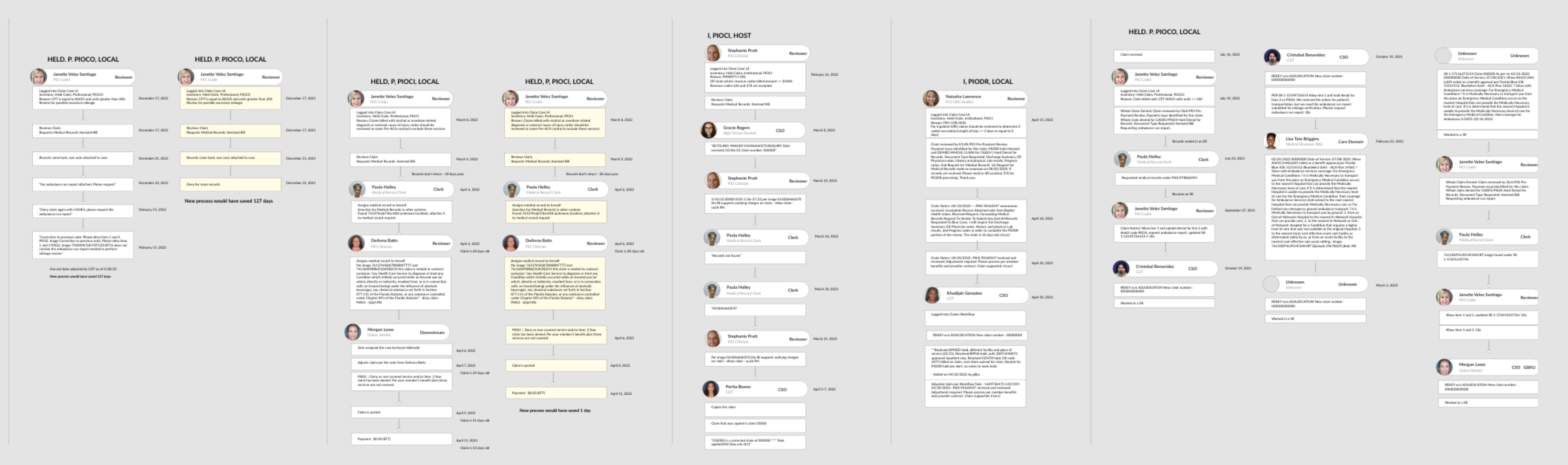
We wanted to explore what it would take to create a dynamic English narrative claim life cycle timeline.
FAILEDWhat I learned: Without Claim Events architecture (which we later developed) it would be near impossible to have this type of mini app. It further confirmed the need to develop the Claim Events architecture. We will be revisiting this POC after the Optum project has been passed to the production team.
This POC we wanted to explore OCR tech where if a PDF is uploaded, the text is converted into data where reviewers can search for phrases through hundreds of pages, highlight, and comment on sections for later audit references.
FAILEDWhat I learned: We weren't quite ready to support this type of tech in-house as it involved training algorithms - and had yet to hire the data scientists we have today.
The business was looking into other vendors to handle this type of review - so we knew if we were to compete with outside parties we needed to sell the business on the fact that we have the talent in house to recreate Optum and Cotiviti's review applications.
SUCCESSWhat I learned: We sold the business on our plan and won the business case funding! The app combined all their painpoints and solved them with a focused claim review portal that customized the screen for each internalized concept. This is where the rubber met the road.
In 3 months we were able to get to production - from the time we won the business case to present. A machine learning model is in production. A true MVP CI/CD pipeline was set up and we are continuously delivering new business value every release.
SUCCESSWhat I learned: Ensuring that everyone had a vested interest and responsiblity to the big picture was more key than the team's technical skills.
 Close up shots of the claims review tool
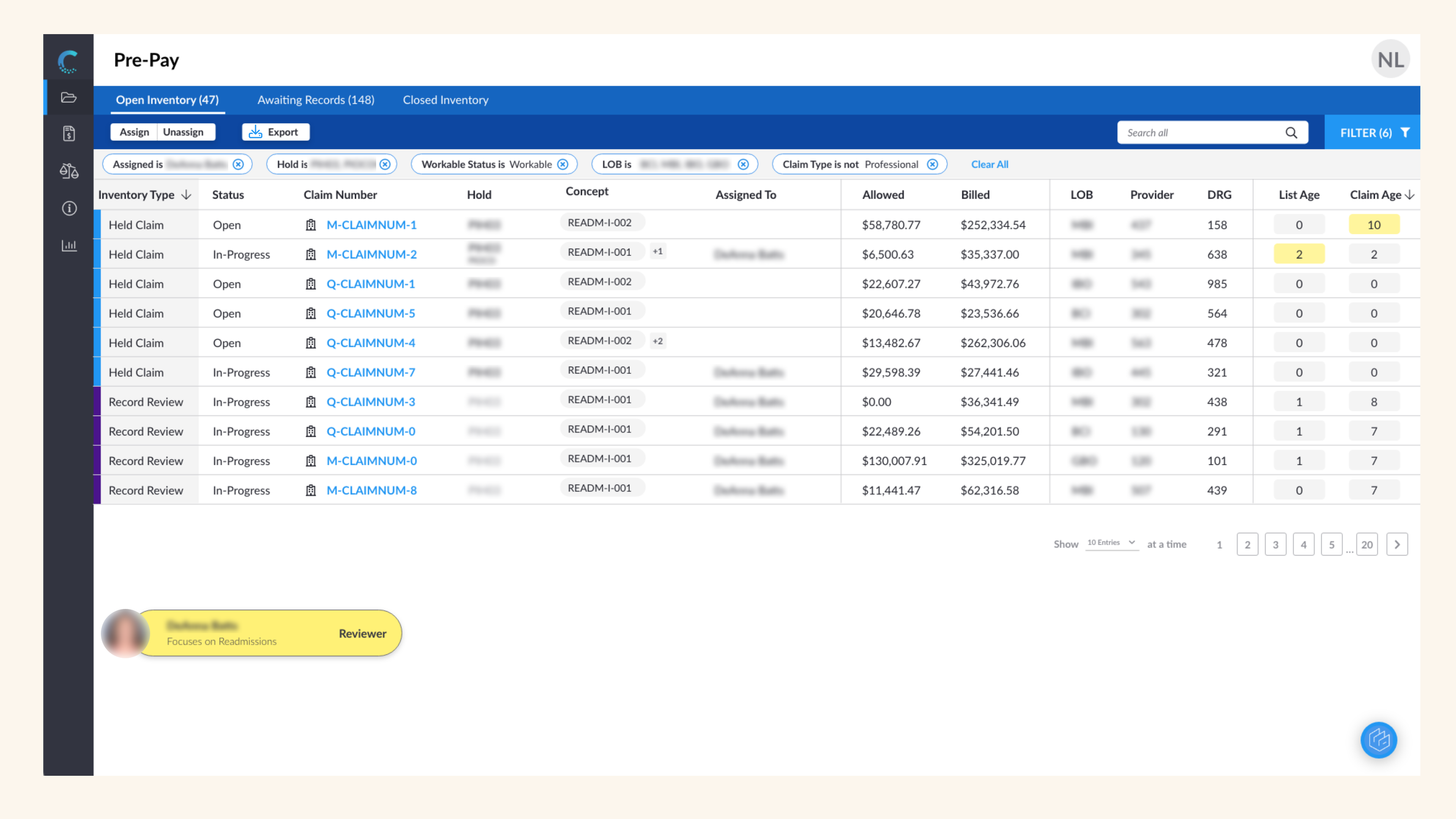
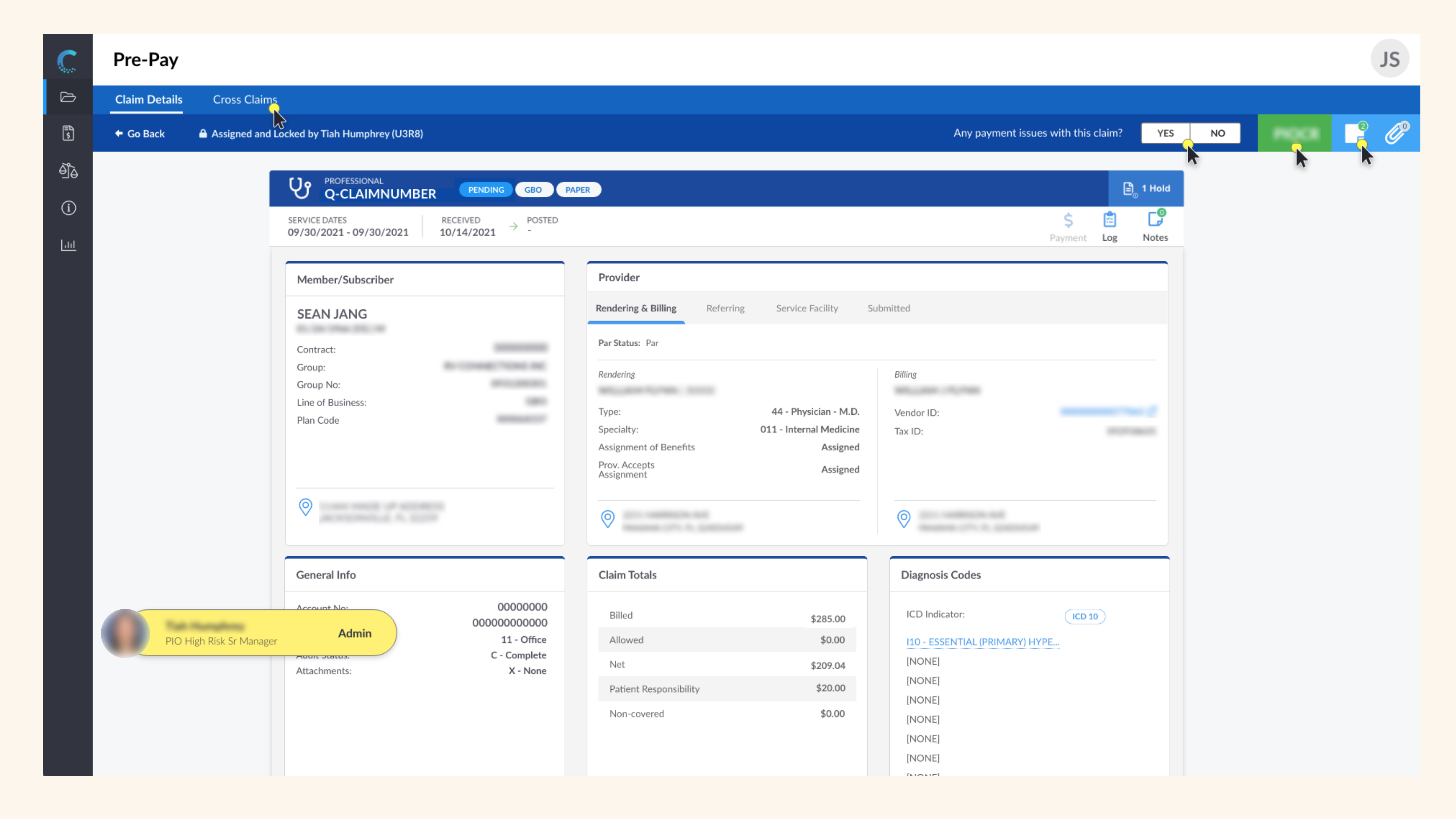 Just a small portion of the claim scenarios
“Everyone should be paying closer attention to the concerns expressed by pregnant women, especially those of color.” Dr. Kelli Tice, Chief Health Equity Officer, Florida Blue.
When I became a user experience and UI designer, I didn't imagine I'd be designing a maternal mental health program. Turns out, my skillset was exactly what this project needed.
Project Bluebird was created to reduce the risk of postpartum depression for Florida Blue members going through pregnancy, with a focus on health equity for black women.
To put it in official wording, the program had to:
Cool. Got it. That's all well and good - just one or two problems.
We had claims data, but claims data doesn't have demographic info and only 30% of our Florida Blue members have demographic information on file. We didn't have data to tell how many black women were currently diagnosed with any mental health conditions, how many black women currently were getting treatment or not, if the rates of postpartum depression were in line with national or state statistics, who had traumatic births that could lead to postpartum depression, etc.
Not for lack of trying at an enterprise level - there was a huge initiative to get demographic information for all members. But guess who answers those types of surveys from a health insurance company? Hint: Not black women (small wonder).

Another problem was there was no official sponsor of this program - maybe it was a culture thing at Florida Blue, but if someone has an innovation idea that isn't for their own business area, you have to prove it out first and then convince a business area to use their already-maxed-out budget to fund the initiative (and the idea of needing a postpartum mental health program came from three first time moms who were Florida Blue employees so there was no sponsor).
Ok, so we had data problems. Trust problems. Funding problems.
We had a tough job ahead, and I was appointed the Lead.
So, I rolled up my sleeves and approached the program design as a user experience problem, considering human centered design. Afterall, what could be more of a human problem than mental health during pregnancy? Over the course of 8 months, I:
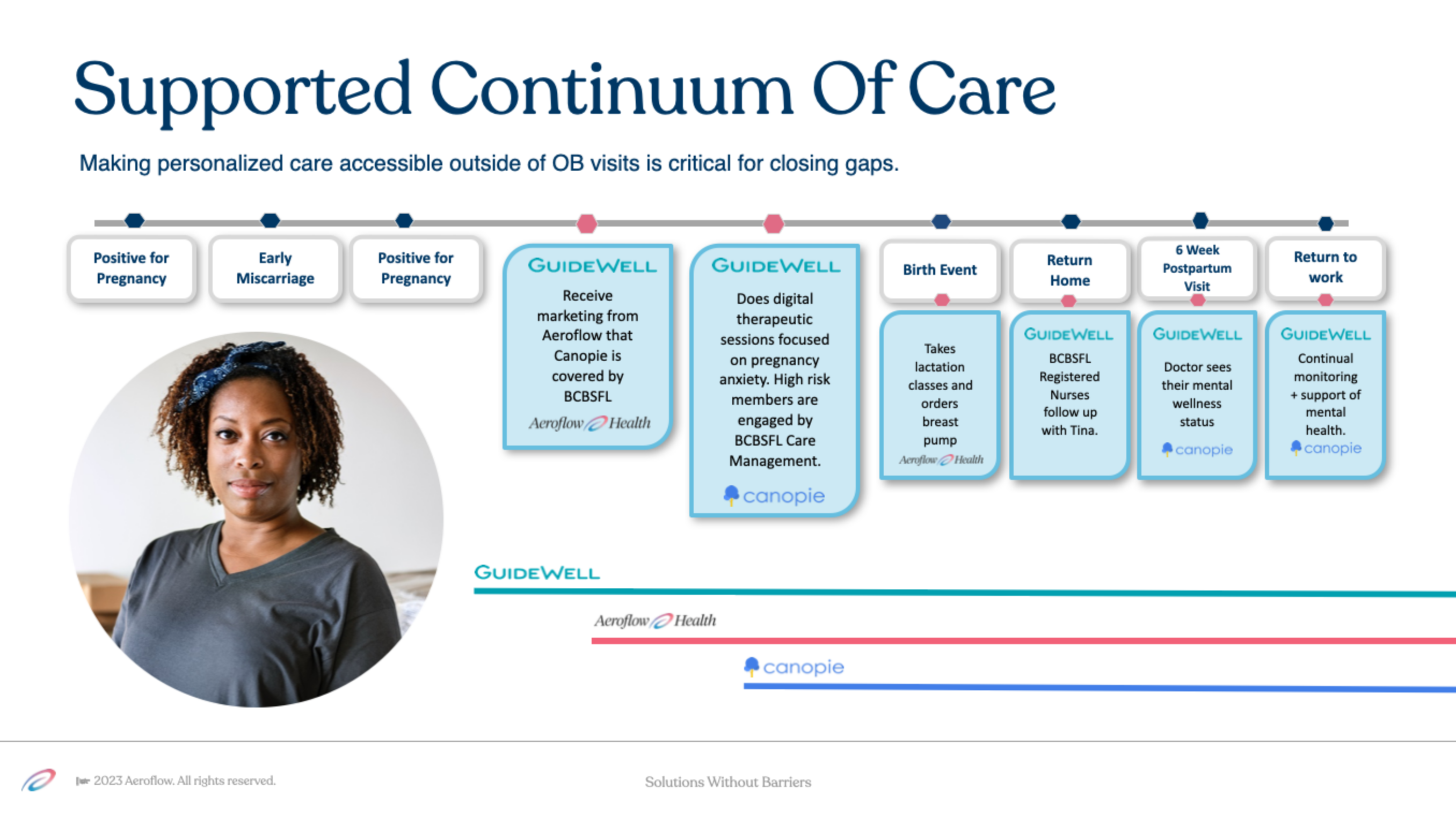
These are some slides from our presentation panel at AHIP 2024. Figure 1 shows our persona Tina's current pregnancy journey, Figure 2 shows how Project Bluebird fits into her pregnancy journey.
Tina's experience with no safety net for her mental health during pregnancy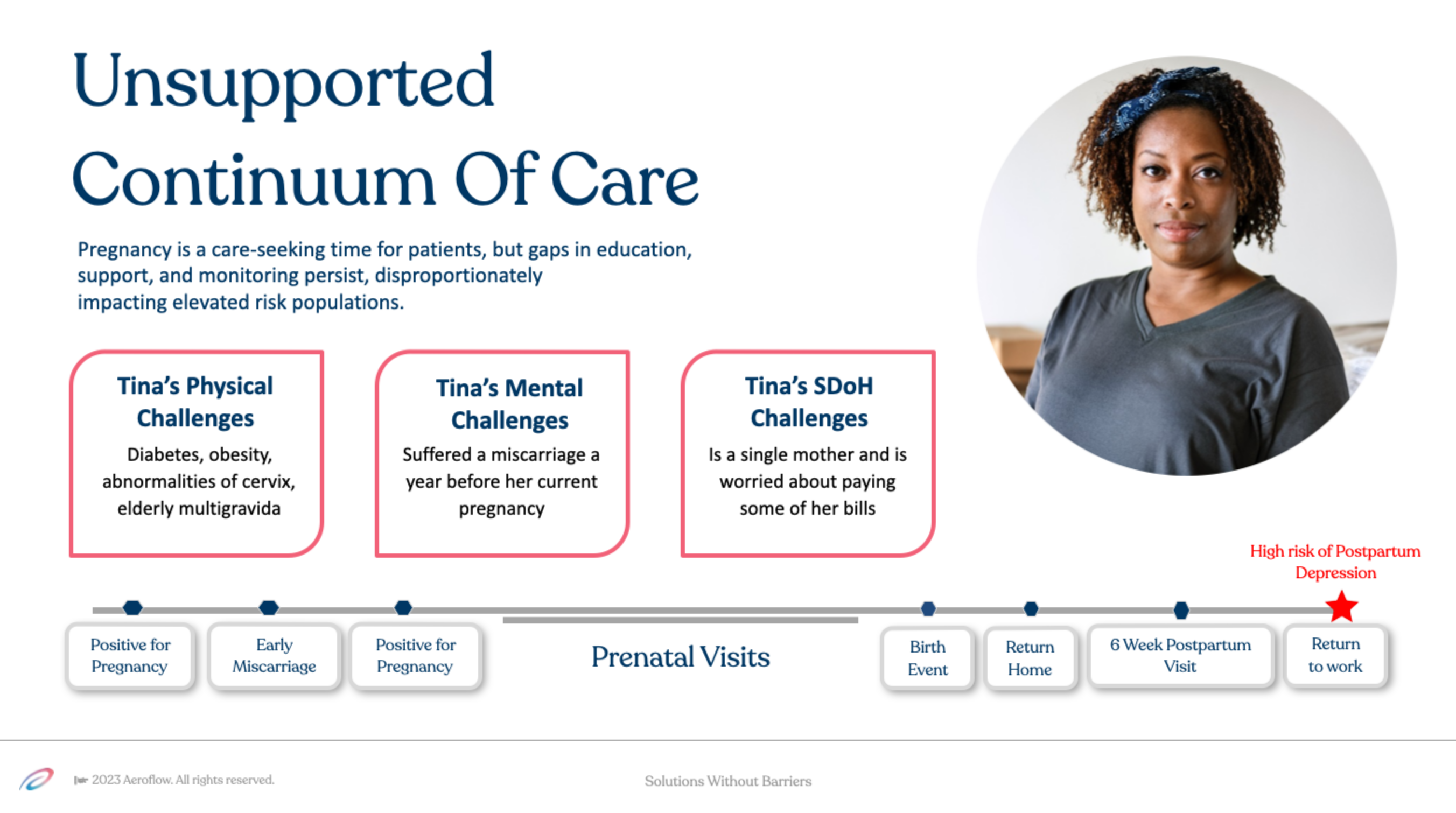 Tina's experience with Project Bluebird
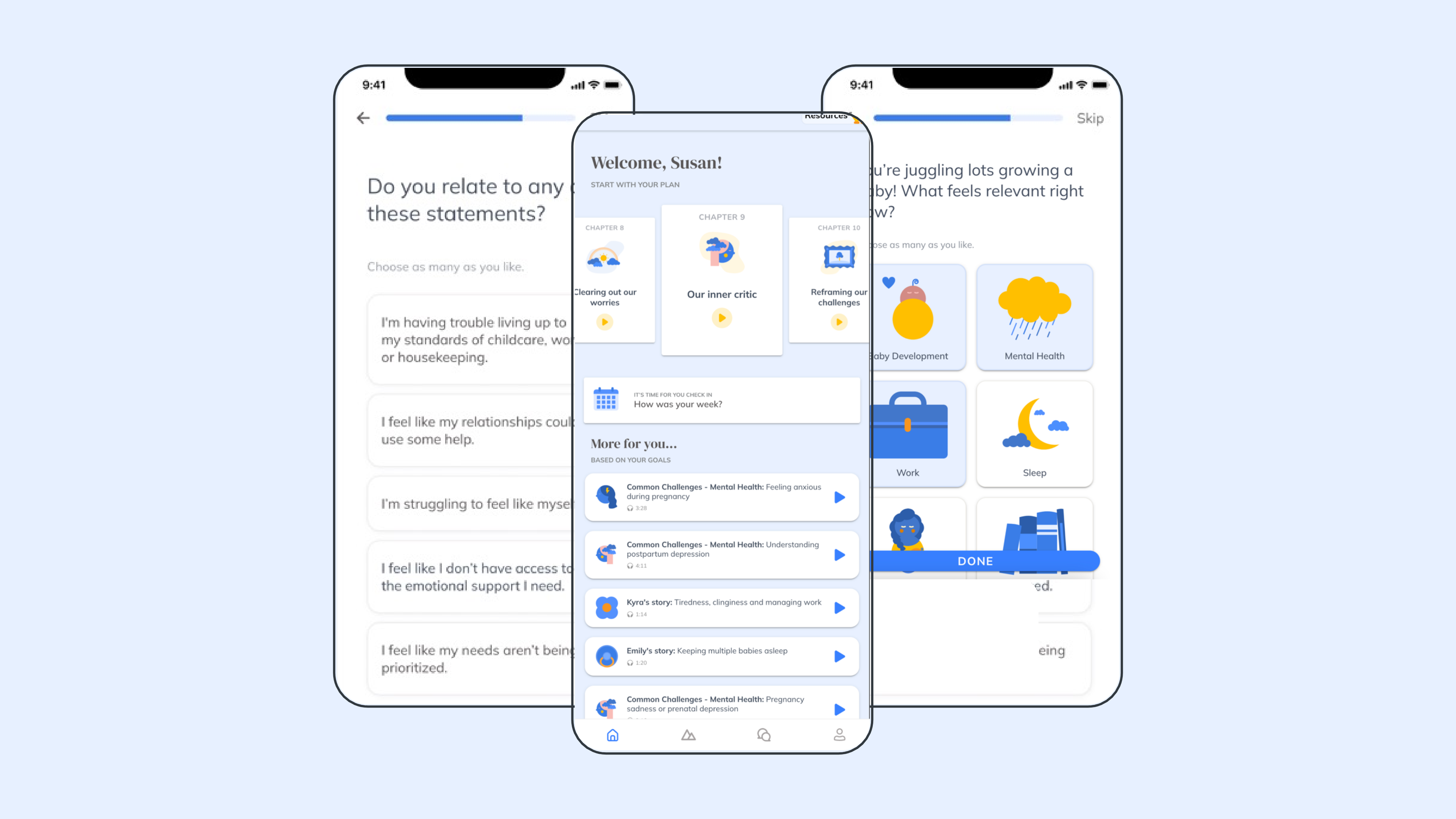
We vetted over 10 different maternal health companies to incorporate a "digital front door" to help triage and categorize members into high-risk vs low-risk. The below high-level user flow includes Canopie, a wonderful woman-owned company who we partnered with to co-design front door to the program and to include their clinically backed mental health modules for pregnancy anxiety and education. We also partnered with AeroFlow, our breast pump DME vendor, to market to members from a trusted brand.

The program went through many many iterations and infinite tweaks - but the results speak for themselves:
89% onboarding completion rateConversion rate of the marketing was industry standard but of the users who downloaded Canopie, 89% completed onboarding.
98% self-reported demographic, mental health concerns, physical concerns, and food/financial concernsSelf-reported data is the gold standard - and we were so grateful with the trust of the women who shared their struggles with us and in turn, we were able to reduce their risk of postpartum depression.
Results of self-reported data via the app 24% of mothers were categorized as having elevated risk
These members were referred to internal care teams - those with physical high risk pregnancy received outreach from our team of Registered Nurses for the duration of their pregnancy through delivery. Those with social risks such as financial or food insecurity received outreach from our social worker team. Those who scored above a threshold on the depression screener received outreach from our Behavioral Health team.
Medical cost savings per engaged member is estimated at $2,000Those who engaged in the mental health modules via Canopie or were referred to our internal teams and tracked at delivery had lower costs, meaning less risk of postpartum depression and pregnancy anxiety. The link of mental health and a healthy delivery cannot be understated, and black women were the most engaged in the program.
You can read the full case study here, to be published in Q4 2024.
Panelists at AHIP 2024: Dr. Cantor (Moderator), Brittany Melhado (Florida Blue first time mom, Consultant), Anne Wanlund (Canopie Founder), Moses Adedoyin (Sr Director of Innovation at GuideWell), Me (Lead Strategist, Innovation Project Lead), Jennifer Jordan (VP, Mom & Baby Division at Aeroflow).
I was honored to share the stage on a panel at AHIP 2024 with Canopie and Aeroflow called "Building Equity Bridges: Integrating Network and Tech to Drive Improved Outcomes” to discuss our methodology and outcomes.

I wish I could inclue the many, many projects I've worked over the last 10 years, but we don't have all day. Please reach out, though, to chat more!
Thanks for reading and let's connect on LinkedIn!